

nextsure

Weather insurance

Parametric weather insurance: a measured weather value triggers the payment, no loss adjuster. How it works and where it pays off.

  • Measurement instead of a loss report
  • Rain, drought and further weather risks
  • Fixed sum, agreed in advance
  • No extra cost
  • Verified partners
  • 100% digital
Weather insurance

Conclude directly online

Verified partner tariffs at no extra cost. The button takes you straight to the provider's calculator.

WETTERHELD logoWETTERHELD

Buy direct

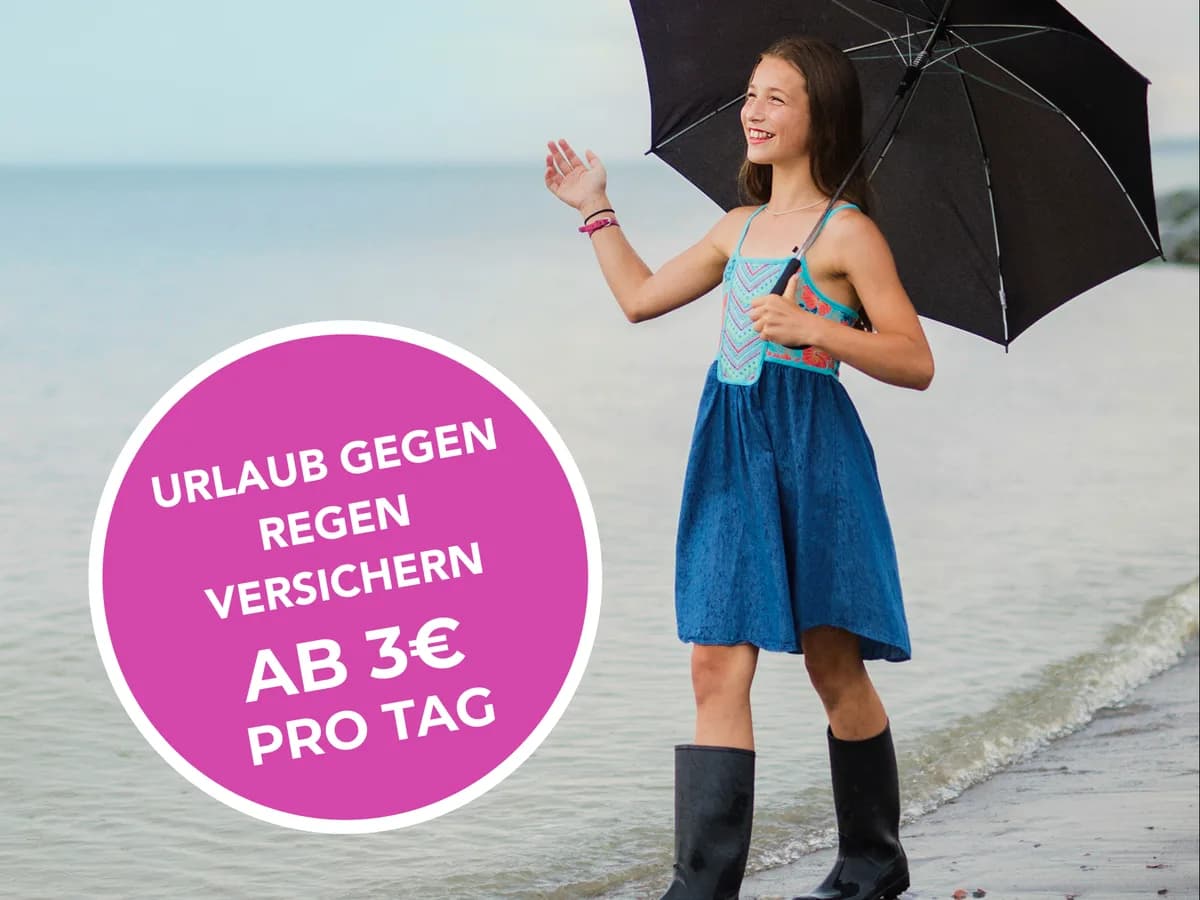
Rain insurance for your holiday

Parametric rain insurance: you set the daily amount, and payment follows the measurement rather than a proof of loss.

Premium:
from 3 EUR per travel day
Payout per rainy day:
50 or 100 EUR
Trigger (example):
over 2.9 mm between 10:00 and 18:00
Buy no later than:
14 full days before departure
Governing weather data:
Meteostat.net
Insured location:
exactly one risk location per contract
  • A fixed payout for every rainy day at the booked holiday location
  • Daily amount of your choice: 50 EUR or 100 EUR per rainy day
  • No proof of loss: the provider checks the measurement data itself
  • Any kind of falling precipitation is covered, from drizzle to hail
  • Cover stays in place if you cut the trip short or never travel
  • Private travel and business trips are equally insurable
Key exclusions
  • Cannot be bought less than 14 full days before departure
  • An overcast sky without measurable precipitation triggers no payment
  • Precipitation outside the agreed time window does not count
  • Only the risk location named in the contract is insured, not the route of a round trip or cruise
  • Rainy destinations carry an excess expressed in rainy days that are not paid out
  • A smartphone weather app is not admissible as evidence
  • Google Rezensionen: 4,9/5 Sterne (49 Bewertungen, Stand 17.08.2026)

    WETTERHELD insgesamt (Anbieterbewertung, alle Versicherungen)

Calculate rate at WETTERHELD

Worked example: with a 3-day excess, a 100 EUR daily amount and a 7-day trip, payment starts from the fourth rainy day. Risk carrier: BD24 Berlin Direkt Versicherung AG (HanseMerkur), since January 2026.


WETTERHELD Rain insurance for your holiday: Payout at a 100 EUR daily amount over a one-week trip

Rainy days in the weekwithout excesswith a 3-day excess
0 rainy days0 EUR0 EUR
2 rainy days200 EUR0 EUR
4 rainy days400 EUR100 EUR
7 rainy days700 EUR400 EUR

All details are taken from the provider's linked product page and the contract documents (IPID/policy conditions) published there; the insurer's documents prevail. Premiums, benefits and the insurance product itself may change – please verify the details directly with the partner before signing up; only the information provided there is binding.

What separates weather insurance from indemnity cover

A classic policy reimburses a documented loss. Weather insurance works differently: it ties the payment to a measurable weather value. If more rain, less rain or less sunshine is recorded at a defined location than agreed, the sum fixed in advance falls due. Whether you actually suffered a loss, and how large it was, is irrelevant to the payout. The technical term is parametric insurance, because a parameter rather than a loss report decides the benefit.

That has two practical consequences. First, claims handling disappears, and with it the weeks between report and money. Second, it makes disadvantages insurable that are hard to quantify: the rained-out holiday, the outdoor revenue that never came in, the weaker harvest. These are exactly the cases that routinely fail an indemnity policy's burden of proof.[1]

The four building blocks of a parametric contract

The parameter

The measured quantity everything depends on, such as rainfall, temperature or hours of sunshine. It appears in the contract with a threshold and a time window.

The risk location

A named location that the measurement applies to. One contract covers exactly one location, not a region and not a route.

The data source

The data set that counts in a dispute. For the WETTERHELD rain insurance that is Meteostat.net, with Kachelmann.com for cross-checking.

The benefit amount

The sum paid when the threshold is crossed, usually per affected day. You choose it when you buy.

Which weather risks can be covered

Cover against too much rain is by far the most widespread. It suits anyone whose plans happen outdoors and cannot be moved. The best-known case is a trip booked for a fixed date.

Its counterpart is drought cover, protection against too little rainfall over a longer period. It is used mainly in agriculture, where a dry spell determines a whole season's yield.

Beyond that, further weather variables such as temperature, wind or hours of sunshine can be agreed individually. Contracts like these are tailored to the single case and are not an off-the-shelf product.[2]

Who buys weather insurance

For private individuals, travel is practically the only relevant case. Book a week on the North Sea coast and you cannot move the date to suit the weather, while a rained-out beach holiday costs twice over: once for the booking, once for the replacement programme.

On the business side it affects everyone whose revenue depends on the weather while their costs run on regardless. Farms cover dry spells, restaurants and leisure venues cover lost outdoor revenue, organisers cover the cost of open-air planning. For travel companies the cover is additionally an add-on module they can offer their own customers.

Weather insurance or natural hazard cover?

The two are often confused, yet they cover opposite cases. Natural hazard cover responds to rare, destructive events and reimburses physical damage to a building or its contents after flooding, backwater or a landslide. Without damage there is no benefit.

Weather insurance covers the reverse: everyday weather that destroys nothing but devalues your plans. Seven days of steady rain cause no physical damage and are therefore in no natural hazard policy. If you need both, you need two contracts. They do not replace one another.

What to check before you buy

Start with the threshold and its time window, because they determine how often the contract triggers at all. A threshold of 2.9 mm between 10:00 and 18:00 is a different proposition from the same amount measured across 24 hours. Check the data source second, and third whether an excess is agreed, meaning a number of days that are not paid out.

Then weigh the premium against the realistic disadvantage. Parametric cover is worth it when a trigger is noticeably expensive for you and the statistical likelihood at the chosen location is not already close to zero or close to one. At either extreme you are paying for nothing, or paying the loss yourself through the premium.

Rain on holiday: the concrete product

For the most common case there is a ready-made product: the holiday rain insurance from WETTERHELD. It pays 50 EUR or 100 EUR for every day on which more precipitation falls at the booked location than agreed. Premiums start at around 3 EUR per travel day, and the contract is concluded at the latest 14 full days before departure.

WETTERHELD is an insurance broker founded in 2019 in Hamburg-Altona, specialised in parametric weather cover. The risk carrier of the rain insurance has been BD24 Berlin Direkt Versicherung AG, a HanseMerkur subsidiary, since January 2026. Details, thresholds and the excess are set out in the offer box further up this page.

Frequently Asked Questions

Weather insurance pays out a sum agreed in advance as soon as a measured weather value crosses a defined threshold. It does not reimburse a documented loss but responds to the measurement alone.

Parametric means a measurable parameter decides the benefit, for instance the amount of rainfall at a given location within a given time window. No loss adjuster is involved.

No. The claim arises with the measurement. Whether you suffered a disadvantage, and how large it was, is not examined.

The most common are too much rain and, in agriculture, too little rain over a longer dry spell. Further variables such as temperature, wind or hours of sunshine can be agreed individually.

No. Natural hazard cover reimburses physical damage from rare events such as flooding or landslides. Weather insurance covers everyday weather without physical damage. Neither replaces the other.

For anyone with a fixed outdoor date and running costs: travellers, event organisers, restaurants and leisure venues, and farms.

Because no claims handling is needed, the provider checks the measurement data itself and pays without delay once you submit the claim. For the rain insurance, bank details plus date and place of birth are enough.

The threshold and its time window, the governing data source, and whether an excess in the form of unpaid days is agreed. Those three points determine how often the contract actually pays.

No. A parametric contract covers exactly one risk location. A round trip or several sites needs a corresponding number of contracts.

Matching additions

Equine surgery insurance

Equine surgery insurance

Horse surgery insurance via nextsure: Three flexible tariffs, reimbursement up to twice the GOT rate, and free choice of clinic worldwide. Protect your horse from high surgery costs – digital, transparent and uncomplicated.

Request Free
Dog Health Insurance

Dog Health Insurance

Comprehensive dog health insurance from nextsure: Optimally protect your loyal companion against vet costs, operations, and unforeseen treatments. Get informed now and calculate your rate!

Request Free
Cat health insurance

Cat health insurance

Comprehensive protection for your feline friend: The cat health insurance from nextsure covers vet costs and ensures financial security in case of illness or accident involving your cat.

Request Free

We help you with any insurance

Information last updated: July 2026 · Source: provider product information (IPID/policy conditions)