
Dental supplementary insurance: benefits, fixed subsidy and your own share of the cost
Fixed subsidy, standard care and your share explained simply: what health insurance pays for dentures in 2026 and how supplemental dental insurance helps.
All details are taken from the provider's linked product page and the contract documents (IPID/policy conditions) published there; the insurer's documents prevail. Premiums, benefits and the insurance product itself may change – please verify the details directly with the partner before signing up; only the information provided there is binding.
 Katrin StraubManaging DirectorInsurance expert with over 20 years of experience in the insurance industry.
Published on
14 min read
Table of Contents
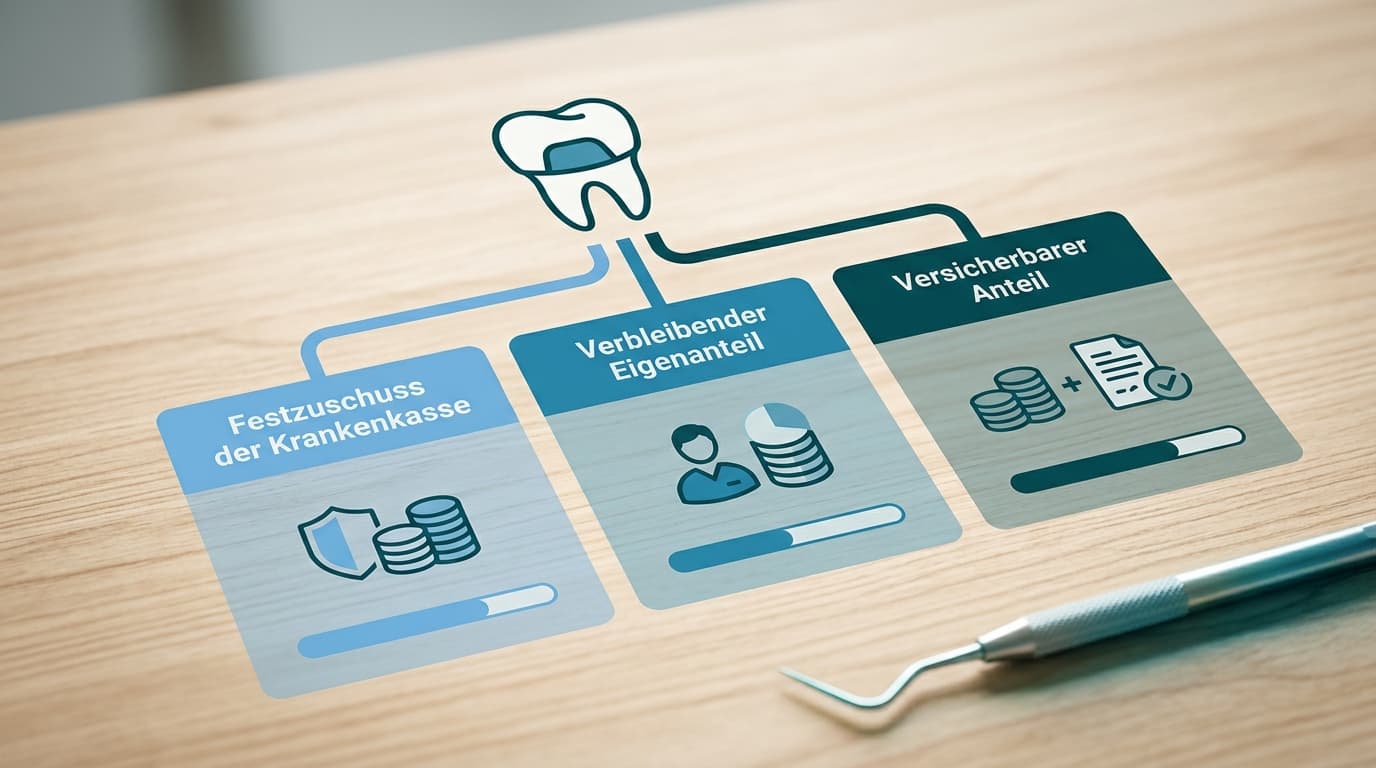
The statutory health insurance fund pays a fixed subsidy for dentures, based on the diagnosis, of 60 percent of the standard care rate — up to 75 percent with a bonus booklet. Everything above that, such as a full ceramic crown, is your own share of the cost. Here you can read how the fixed subsidy, standard care and your own share interact, and which part of your bill is insurable at all.
dental supplementary insurance
Find the right dental supplementary insurance at nextsure. Comprehensive protection, digital processing, and tailor-made rates for your most beautiful smile.
Learn moreHow the insurance fund calculates: fixed subsidy and standard care
The statutory health insurance fund pays a fixed subsidy for dentures, based on the diagnosis, amounting to 60 percent of the average costs of standard care (§ 55 SGB V) — never a percentage of your actual bill. That is the crucial point: the subsidy is based on the standard therapy for your diagnosis, not on the treatment your dentist proposes. If you choose a higher-quality solution, your own share grows while the subsidy stays the same.
How the system works: before any denture treatment, your dentist determines the dental diagnosis — for example, tooth substance requiring a crown or a single-tooth gap. For each of these diagnoses, the Gemeinsamer Bundesausschuss (G-BA) defines which treatment constitutes standard care and which average costs are assumed for it; this is adjusted annually.[1] The catalogue of the fixed subsidy directive covers more than 50 individual diagnoses, each with its own fixed subsidy amount.[2]
Standard care is the treatment that constitutes the standard therapy for the given diagnosis: according to the Social Code, it must be sufficient, appropriate and economical.[2] For a crown in the posterior tooth area, for example, this is a metallic full crown without veneering; for a single-tooth gap, a bridge. These benefits are scientifically validated and have endured because they work well. However, they are deliberately defined as the most cost-effective solution.
Your freedom of choice does not change the statutory benefit. You may choose any scientifically recognised treatment option, for example an all-ceramic bridge instead of the metallic standard care or an implant instead of a bridge. The fixed subsidy is never lost, but it remains exactly the same amount. You cover the difference between the total cost of your preferred solution and the fixed subsidy as your own share.[1]
| Type of care | What the health fund pays | Who bears the extra costs |
|---|---|---|
| Standard care (Regelversorgung) | [1]Fixed subsidy of 60% of the assessed costs | [2]Only the statutory own share of around 40% |
| Equivalent care | The same fixed subsidy as for standard care | The extra costs for additional services |
| Non-equivalent care | The same fixed subsidy as for standard care | The entire extra costs, billed according to the GOZ |
This is exactly the gap that supplementary dental insurance closes: it kicks in where the fixed subsidy ends and reimburses an agreed share of the costs that go beyond standard care. How high your own share is in a given case depends on three factors: your bonus booklet, the treatment you choose, and the reimbursement basis of your policy. The next sections go through the three factors one by one.
Bonus booklet and hardship cases: when the subsidy increases
The fixed subsidy of 60 percent is the lower limit. With a fully documented bonus booklet, in which your dental check-ups are recorded, the subsidy rises to 70 percent after five years and to 75 percent after ten years (§ 55 SGB V).[2] For a crown, that means as of 1 January 2026: 239.03 euros without a bonus, 278.87 euros after five years, and 298.79 euros with a ten-year bonus booklet.[1]
- Without a bonus booklet: fixed subsidy of 60 percent of standard care.
- Bonus booklet kept without gaps for five years: 70 percent.
- Bonus booklet kept without gaps for ten years: 75 percent.
- Exception, hardship rule (only for low incomes): instead of 60 to 75 percent, the health fund covers the costs of standard care in full, i.e.[1] 100 percent of those costs, not 100 percent of your invoice.
A single lapse does not have to cost you your ten-year bonus level. According to a ruling by the Federal Social Court (Bundessozialgericht) of 28 May 2026 (case no. B 1 KR 22/25 R), a single missed examination year within the ten-year period can remain without consequence if you give the health fund sufficient reasons why the appointment was not possible. The bonus year 2020 counts as fulfilled for all members of statutory health insurance anyway due to the coronavirus pandemic.[3][1]
For those on low incomes, the hardship rule applies: if you choose standard care in this case, the health fund covers its costs in full. In 2026 the income threshold is 1,582 euros in gross monthly income for single people and 2,175.25 euros with one dependant, with a further 395.50 euros added for each additional dependant.[1] Even above these thresholds, the so-called sliding hardship rule can bring an increased subsidy, so it can be worth asking your health fund with proof of income.[4]
Important for context: even in a hardship case, the subsidy applies only to standard care. If you choose a higher-quality solution, the subsidy remains limited to the costs of standard care — 398.39 euros for a crown — and you pay the additional costs on top yourself.[1] Keeping a bonus booklet is still worthwhile for everyone: it is the only free increase the system offers.
Worked example: a crown — how your own share adds up
A concrete example shows how the fixed subsidy, standard care and your own share relate. For a full metallic crown in the posterior tooth region, a total of 398.39 euros is assessed in 2026 — that is the standard care for this finding.[2] The health fund pays 239.03 euros of that without a bonus booklet, or 298.79 euros with a ten-year bonus booklet.[1] Your own share for the standard crown alone is therefore around 99 to 159 euros depending on your bonus level.[5]
Things change if you want a higher-quality crown. A full ceramic crown costs around 600 to 900 euros in 2026, depending on the effort involved and the region.[5] The fixed subsidy is unaffected by this: it continues to be based on the metallic standard care, i.e. 239.03 euros without a bonus or 298.79 euros with a ten-year bonus record. Your own share is calculated as total costs minus the fixed subsidy.
| Scenario 2026 | Total costs | Fixed subsidy | Your own share |
|---|---|---|---|
| Metallic full crown, without bonus record | [2]€398.39 | [1]€239.03 | [5]around €159 |
| Metallic full crown, 10-year bonus record | €398.39 | €298.79 | around €99 |
| Full ceramic crown, without bonus record | €600 to 900 | €239.03 | around €360 to 660 |
| Full ceramic crown, 10-year bonus record | €600 to 900 | €298.79 | Total costs minus fixed subsidy, i.e. around €60 less than without a bonus record |
The calculation reveals the core problem of the fixed subsidy system: the subsidy stays the same, no matter which type of care you choose. You alone bear the additional costs of the higher-quality solution. With a full ceramic crown, that amounts to several hundred euros in 2026 – per crown. With a bridge with several crowns or implant treatment, this amount multiplies accordingly. It is precisely this share of the additional costs that is the part of your bill that a dental supplementary insurance can cover.
The three coverage areas of a dental supplementary insurance
A dental supplementary insurance reimburses in three areas, and each area has its own reimbursement rate in the tariff. This is important to know, because a tariff with 100 percent reimbursement for dentures can be significantly lower for dental treatment – and vice versa. The three areas at a glance:
- Dentures: crowns, bridges, inlays, implants and dentures. This is the area where the fixed subsidy gap is largest and where the reimbursement rates of the tariffs vary the most.
- Dental treatment including prophylaxis: plastic fillings, root canal treatments, periodontitis treatments and professional dental cleaning, which those with statutory insurance usually have to pay for entirely themselves. Some tariffs reimburse 100 percent of the bill here, often with maximum amounts per measure and calendar year.
- Orthodontics: braces and aligner therapies, often with their own benefit limits in the tariff and sometimes only for certain severity levels of jaw misalignment.
To put the areas into context: dental treatment covers everything your dentist treats on existing teeth, while dentures replace missing or severely damaged teeth. Orthodontics is a separate area because it often runs over several years and therefore needs its own benefit limits. Which area is relevant for you depends on your situation: if you are facing denture treatment, you mainly need the first area; if you go for prophylaxis regularly, you benefit from the second.
These three areas are also the yardstick against which you should read every tariff: check for each area individually what percentage is reimbursed, what basis the reimbursement refers to and what maximum amounts apply. A tariff that is only strong in one area will hardly help you if your upcoming treatment falls into another.
What is insurable at all: reimbursement basis and limits
Not the entire bill is automatically insurable, and the reimbursement basis determines how much is actually reimbursed in the end. It refers to the amount on which your tariff's reimbursement rate is based. Good tariffs apply the benefit to the private bill amount, i.e. your full bill according to the fee schedule for dentists (GOZ).[6] Weaker tariffs only refer to the part that the health insurance fund subsidises, i.e. the standard care – then even a high percentage reimburses you only a fraction of your actual costs.
The quality of a tariff is therefore shown by two figures together: the reimbursement basis and the reimbursement rate. High-quality tariffs reimburse 80 to 95 percent of the bill amount, some are at 100 percent.[6] The order matters: first, the health insurance fund settles its fixed subsidy directly with the practice, after which the tariff reimbursement refers to the amount that remains as your own share on your bill. With a full ceramic crown at the upper end of the price range, i.e.[5] total costs of around 900 euros, around 660 euros of your own share remain without a bonus record, of which a good tariff covers the vast majority.
On top of that come limits that every tariff sets differently. Omitting them would be the mistake that hits you hardest, because they determine what is actually reimbursed in the first few years:[6]
- Dental scale (Zahnstaffel): a cap on reimbursement during the first three to five insurance years at maximum amounts that rise from year to year and only disappear entirely after that.
- Maximum amounts per benefit: for example, for professional teeth cleaning, often with a fixed upper limit per calendar year.
- Exclusion of ongoing treatments: treatments already recommended or started are excluded in most tariffs or only insurable at an extra premium.
- Limits on material and laboratory costs: some tariffs cap exactly the part of the bill that makes up the largest share with high-quality dentures.
Does that apply to you? Supplementary dental insurance is worthwhile above all when two conditions come together: you want to keep the option of high-quality dentures open, such as full ceramic instead of metal, and your teeth are currently free of any treatment recommendation, so that no ongoing treatment blocks the conclusion. If standard care is enough for you, you usually pay more for the policy than it brings you.[6] Which tariff fits your situation is something a general article cannot answer: what matters are the reimbursement rate, the reimbursement basis and the limits of the first insurance years.
Outlook and next steps
Today's status: the fixed subsidy covers 60 percent of standard care, up to 75 percent with a bonus booklet, and is based solely on the diagnosis, never on your bill. The fixed subsidy amounts are re-set annually, most recently by resolution of the Gemeinsamer Bundesausschuss of 5 December 2025, effective 1 January 2026. How the amounts will develop in the future and whether tariff conditions will change cannot be reliably predicted from today's vantage point – tariffs and statutory rules are constantly adapting.[7]
So the general rule is: the statutory health insurer only contributes to the standard therapy for your diagnosis. The distinction that decides your case is the question of whether you are satisfied with this standard therapy or whether you want high-quality dentures – in the latter case you bear the extra costs yourself, and that is exactly what supplementary dental insurance is for. Whether and to what extent taking out a policy pays off for you depends on the condition of your teeth, your bonus booklet and your expectations. A general article cannot resolve this individual case.
As a next step, you can use nextsure's supplementary dental insurance service: nextsure compares tariffs transparently, advises you independently and handles the contract conclusion fully digitally. In a personal consultation, you can clarify which tariff fits your dental situation and what reimbursement you can expect for a planned treatment.
Frequently asked questions
- How high is the statutory health insurance fixed subsidy for dentures in 2026?
The insurer pays a findings-based fixed subsidy of 60 percent of the average cost of standard care (§ 55 SGB V). With a gapless bonus booklet, it rises to 70 percent after five years and 75 percent after ten years. For a metal full crown as standard care, a total of 398.39 euros is set for 2026; the insurer pays 239.03 euros of that without a bonus and 298.79 euros with the maximum bonus.
- Is the fixed subsidy a percentage of my dentist's bill?
No. The fixed subsidy is based exclusively on standard care, i.e. the standard therapy stored for your findings in the fixed subsidy directive. If you choose a higher-quality restoration such as a full ceramic crown or an implant, the subsidy remains unchanged and the additional amount becomes your own share.
- What does a full ceramic crown cost and how much do I pay myself?
A high-quality full ceramic crown costs around 600 to 900 euros in 2026. Deducting the fixed subsidy of 239.03 to 298.79 euros leaves an own share of several hundred euros depending on bonus status, around 660 euros in the upper price range. The exact amount is stated in the treatment and cost plan drawn up by the practice before treatment.
- What benefits does dental supplementary insurance cover?
The plans reimburse in three areas: dentures (crowns, bridges, inlays, implants, dentures), dental treatment including prophylaxis (such as fillings, root canal treatments, professional teeth cleaning) and orthodontics. Each area has its own reimbursement rates in the plan and sometimes its own limits, such as maximum amounts for professional teeth cleaning.
- Is dental supplementary insurance worth it from age 50?
It depends on your expectations. If you want high-quality dentures such as full ceramic or implants, supplementary insurance can cover a large part of your own share; good plans reimburse 80 to 95 percent of the invoice amount. The premium rises with your entry age, and treatments already recommended or started are usually excluded. Full benefits are also only available after the first insurance years.
- What does standard care mean for dentures?
Standard care is the standard therapy that the Gemeinsamer Bundesausschuss has defined for each findings in the fixed subsidy directive. It must be sufficient, appropriate and economical, for example a metal full crown in the posterior tooth area. Statutorily insured persons are entitled to it; additional costs for higher-quality materials are borne by them.
- When does the health insurance pay 100 percent for dentures?
Only in cases of hardship. Insured persons with particularly low incomes receive a fixed subsidy of 100 percent and thus full coverage of standard care, while everyone else stays at 60 to 75 percent. The income threshold for 2026 is: 1,582 euros for single persons and 2,175.25 euros for insured persons with one dependent, plus 395.50 euros for each further dependent. Those slightly above the threshold can receive an increased subsidy via the sliding hardship rule.
Sources
Conclude directly online
Verified partner tariffs at no extra cost. The button takes you straight to the provider's calculator.
 Advigon
Supplemental dental insurance
Four supplemental dental tariffs ranging from basic cover to full protection, including children's tariffs with orthodontics.
- Dental Medium premium:
- €5.69-32.30/month depending on age
- Dental Luxus premium:
- €9.20-54.50/month depending on age
- Waiting period:
- none (AZM/AZL)
- Dental treatment: 75% (Dental Medium) or 100% (Dental Luxus)
- Dentures/crowns (Zahnersatz): 75% (AZM; 100% for standard care) or 100% (AZL)
- Preventive dental care: 100% up to €90/year (AZM) or up to €140/year (AZL)
- No waiting periods in Dental Medium and Dental Luxus
- Children's tariffs with orthodontics (KFO): Dental Clever €9.68/month, Dental Premium €18.76/month
- Stiftung Warentest rated Dental Premium "very good" (1.5) (Finanztest 2/25)
Key exclusions
- Reimbursement caps in the first 48 months: AZM €600-2,400, AZL €1,000-4,000 (tiered)
- No explicit benefit exclusions are stated in the available documentation
Stiftung Warentest „SEHR GUT (0,6)“, Finanzen 07/2025 (285 Tarife im Test)
Advigon Zahnzusatzversicherung Dental Luxus (AZL)
MORGEN & MORGEN M&M Rating Zahnzusatz: 5 Sterne „Ausgezeichnet“ (08/2023)
Advigon Versicherung AG, Dental Luxus (AZL)
Reimbursement caps do not apply in the case of an accident, after month 48, or with a recognized prior policy.
Fact sheet: benefits, exclusions and waiting periods in detail
 die Bayerische
Supplemental dental insurance
Supplemental dental cover in three tariffs (Smart, Komfort, Prestige) with no waiting period; the top tariff reimburses 100%.
- Reimbursement:
- 75-100% depending on the tariff
- Waiting period:
- none
- Teeth cleaning:
- €80-200/year depending on the tariff
- Zahn Sofort module:
- €29.90/month, ends after 2 years
- Dentures/crowns and dental treatment: Smart 75%, Komfort 80-100%, Prestige 100%
- Professional teeth cleaning in all tariffs (€80-200 per calendar year)
- No waiting periods in any of the three tariffs
- Orthodontics: €1,500 (including statutory health insurance benefit) or €2,000 (without statutory health insurance benefit) in Komfort and Prestige
- Prestige includes teeth whitening and a Happybrush sonic toothbrush
- Stiftung Warentest 07/2025: Zahn Prestige rated test winner with "very good" (0.5)
Key exclusions
- Treatments recommended or started before the policy began (only covered via the Zahn Sofort module)
- A flat 40% deduction for dentists without statutory-insurance accreditation
- Reimbursement capped at up to 3.5x the dental fee schedule (GOZ) rate
- Abroad, reimbursement is capped at the domestic benefit level
Stiftung Warentest „SEHR GUT (0,5)“, Ausgabe 07/2025 (285 Tarife im Test)
die Bayerische, Tarif ZAHN Prestige
ASCORE „Tarif des Jahres 2024“ (Krankenzusatz Zahn)
die Bayerische, Zahn Prestige 2023
Levelnine Rating „EXZELLENT“ (Stand 11/2024, gültig bis 11/2025)
die Bayerische, Tarif ZAHN Prestige
Benefit tiering: €500 in year 1 (Smart), €1,250 (Komfort), or €1,500 (Prestige); unlimited from calendar year 5; caps also do not apply in the case of an accident.
Fact sheet: benefits, exclusions and waiting periods in detail
Advigon Supplemental dental insurance: Benefits: Dental Medium (AZM) and Dental Luxus (AZL)
| Benefit | Dental Medium (AZM) | Dental Luxus (AZL) |
|---|---|---|
| Dental treatment | 75% | 100% |
| Pain therapy | 75% | 100% |
| Preventive dental care | 100% up to €90/year | 100% up to €70 per treatment, up to €140/year |
| Dentures/crowns | 75% (100% for standard care) | 100% |
| Monthly premium by age | €5.69-32.30 | €9.20-54.50 |
die Bayerische Supplemental dental insurance: Tariff comparison: Smart, Komfort, Prestige
| Benefit | Smart | Komfort | Prestige |
|---|---|---|---|
| Dentures/crowns (above standard care) | 75% | 80-90% | 100% |
| Dentures/crowns (up to standard care) | 75% | 100% | 100% |
| Dental treatment | 75% | 100% | 100% |
| Professional teeth cleaning | €80/calendar year | €100 per treatment, max. €150/year | €100 per treatment, max. €200/year |
| Orthodontics | not included | €1,500 (incl. statutory insurance) / €2,000 (excl. statutory insurance) | €1,500 (incl. statutory insurance) / €2,000 (excl. statutory insurance) |
| Teeth whitening | not included | not included | included |
| Example annual premium (age 33) | €152.40 | €244.80 (rural) / €321.60 (urban) | €405.60 (rural) / €529.20 (urban) |
All details are taken from the provider's linked product page and the contract documents (IPID/policy conditions) published there; the insurer's documents prevail. Premiums, benefits and the insurance product itself may change – please verify the details directly with the partner before signing up; only the information provided there is binding.
Information last updated: July 2026 · Source: provider product information (IPID/policy conditions)