What does a classic car cost in insurance and tax?
Youngtimer insurance compared: find out what insurance and tax cost, which conditions apply and how to protect your modern classic.
All details are taken from the provider's linked product page and the contract documents (IPID/policy conditions) published there; the insurer's documents prevail. Premiums, benefits and the insurance product itself may change – please verify the details directly with the partner before signing up; only the information provided there is binding.
 Katrin StraubManaging DirectorInsurance expert with over 20 years of experience in the insurance industry.
Published on
10 min read
Table of Contents
A youngtimer offers driving pleasure with the potential to gain value. Specialist enthusiast policies insure the market value rather than merely the current value, and despite ordinary vehicle tax they are often cheaper than normal car insurance.
Classic car insurance
Discover nextsure's tailor-made classic car insurance. Optimal protection, digital processing, and expert advice for your automotive treasure.
Learn moreYoungtimer or classic: which status applies to your car
On German roads, the distinction between a youngtimer and a classic car rests primarily on the vehicle's age from the day it was first registered. Youngtimers are defined as vehicles between 20 and 29 years old, whereas a car only attains official classic status once it is a full 30 years old. That age threshold is by no means a matter of interpretation: it is the legal basis for registration options, tax concessions and the availability of tailored insurance policies.
| Distinguishing feature | Youngtimer (20 to 29 years) | Classic car (30 years and over) |
|---|---|---|
| Vehicle age | 20 to 29 years since first registration | At least 30 years since first registration |
| Official registration | Ordinary or seasonal registration | "H" registration or red "07" plates possible |
| Condition requirements | Good, well-maintained condition with no serious defects | An inspection under section 23 StVZO for originality and condition |
| State vehicle tax | Ordinary taxation by engine capacity and emissions class | Flat-rate vehicle tax of 191.73 euros a year |
| Insurance model | Tailored youngtimer and enthusiast policies | Specialist classic car insurance with market-value cover |
Condition, inspections and insurers' criteria
For a vehicle to enjoy the state concessions available to a classic car, the vehicle registration regulations require an official inspection under section 23 StVZO. An inspection engineer assesses whether the car largely corresponds to its original condition and is well maintained. No such official special registration exists for youngtimers. Even so, specialist insurers set clear criteria: alongside a fixed maximum annual mileage, many providers require a minimum vehicle value and the presence of an ordinary everyday car.
Which cover suits you therefore depends largely on your vehicle's status. Classic motor policies usually reimburse only the rapidly falling replacement value of a used everyday car when a claim arises, whereas transparent enthusiast policies insure the genuine market value. Youngtimer owners still pay ordinary vehicle tax, but straightforward specialist policies let them close the financial gap as well as possible until the 30-year mark is reached.
Specialist policy versus ordinary motor cover: why standard insurance often fails
Insuring a well-kept youngtimer through an ordinary car policy not infrequently leads to an expensive surprise when you claim. Ordinary motor policies are geared consistently to the steady depreciation of everyday vehicles. After an accident writing the car off, or after a theft, conventional companies therefore reimburse only what is known as the current value as standard. For vehicles 20 to 30 years old, general trade-guide tables put that value extremely low. The actual value to an enthusiast, painstaking maintenance or restoration work carried out simply do not enter into it.
Guaranteed value and premium stability compared
| Feature | Standard motor insurance | Specialist youngtimer insurance |
|---|---|---|
| Payment on a total loss | Purely a current value (large deduction) | The actual market or replacement value |
| Premium calculation | No-claims discount classes | A fixed premium based on value and use |
| Consequences of a claim | Loss of no-claims discount and higher premiums | No loss of discount when you claim |
| Additional cover | Vandalism only through expensive fully comprehensive cover | Often already included in extended partial comprehensive cover |
A specialist enthusiast policy follows a fundamentally different philosophy. Rather than classifying the car as a worn-out used vehicle, tailored youngtimer insurance covers its genuine market value. That value is established in advance by a short valuation or representative photographs. If your classic's market value rises over the years, the sum insured can be adjusted flexibly to avoid the danger of being under-insured.
Specialist insurers also generally do without the no-claims discount system on enthusiast policies. For owners, that means complete peace of mind: a comprehensive claim you have to report does not lead to years of increased premiums. We recommend that all lovers of modern classics opt from the outset for a transparent, tailored solution that protects the car's actual value.
Costs compared: what insurance and tax cost for a youngtimer
Two main items determine the annual fixed costs of running a classic: state vehicle tax and the insurance premium. Historic vehicles aged 30 and over can use a single flat rate of tax with the "H" registration, but separate tax and insurance rules apply to youngtimers aged 20 to 29.
| Criterion | Youngtimer (20–29 years) | Classic car (30 years and over) |
|---|---|---|
| Minimum age | 20 years | 30 years |
| State vehicle tax (cars) | Ordinary, by engine capacity & emissions class | A flat €191.73 a year |
| Basis of insurance | Market value & individual use | Market value / valuation figure |
| Who it is for | Enthusiasts who love maintaining their car | Recognised automotive heritage |
Specialist policies absorb the higher tax cost
Because youngtimers do not yet fall under flat-rate taxation, the tax is based on engine capacity and the relevant emissions class. With older catalytic converters or large-capacity engines, the tax is therefore often noticeably higher than the fixed flat rate for classics. On the other hand, specialist enthusiast policies cushion that burden: compared with ordinary everyday motor insurance, tailored youngtimer policies do without the rigid logic of classic no-claims discount classes. Instead, the premium is calculated primarily on the actual market value and the annual mileage agreed.
Owners of well-maintained vehicles therefore benefit from comparatively low insurance premiums that offset the ordinary tax burden in the overall calculation. Combining this with a seasonal registration or an up-to-date valuation optimises the overall financial picture further, without giving up the agreed market-value cover when you claim.
Insurers' requirements: garage, everyday car and mileage limit
Specialist enthusiast policies for youngtimers offer first-class cover at often surprisingly low premiums. To make those preferential terms possible, however, insurers set precise requirements for both owner and vehicle. The providers' aim is clear: these affordable specialist policies are reserved for well-kept enthusiasts' cars that are driven gently and protected from everyday hazards.
The central acceptance criteria at a glance
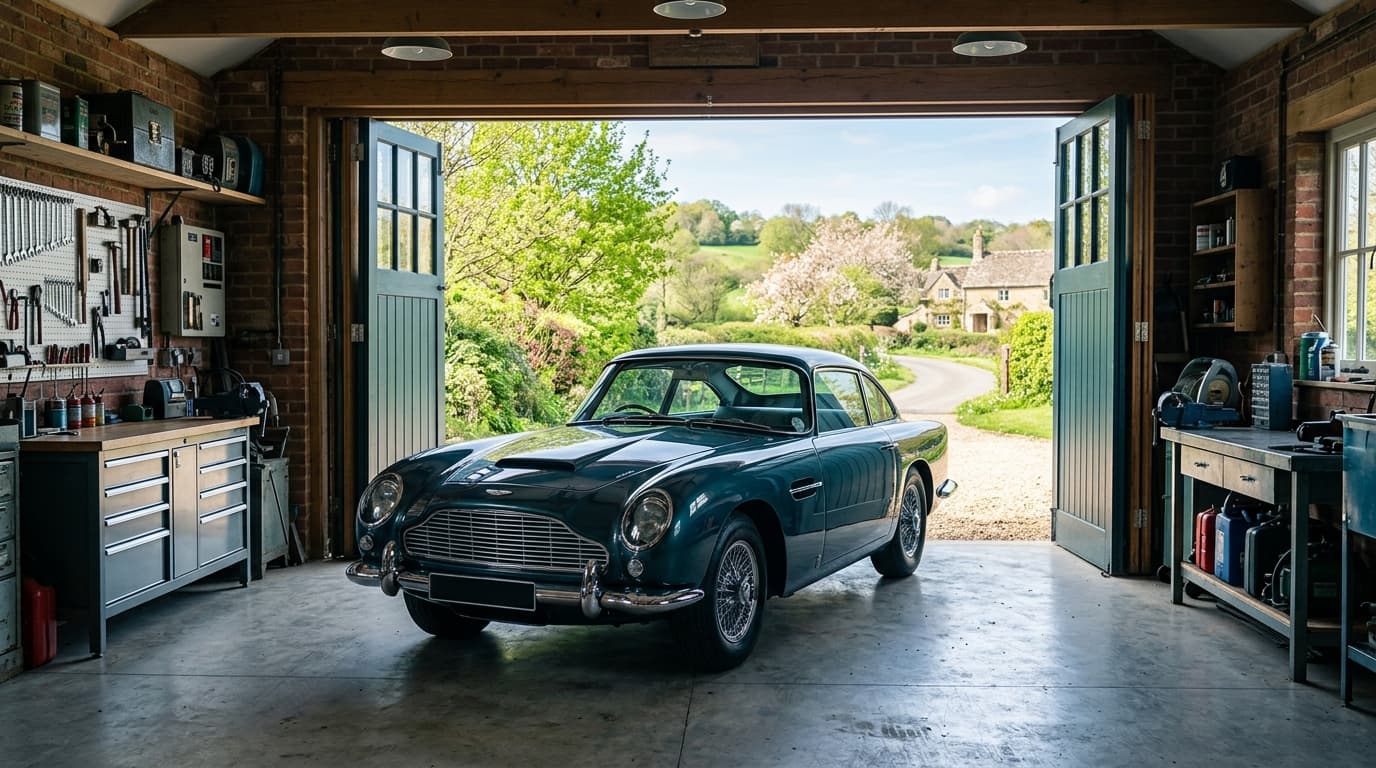
- An enclosed parking space: the vehicle must usually be kept in a locked single or double garage, a secured underground car park or at least under a sheltered carport on enclosed land. That minimises the risk of theft, vandalism and storm damage.
- An everyday car in the household: insurers almost always require evidence of a primary vehicle. An ordinarily registered primary car in the name of the keeper or someone in the same household makes sure the youngtimer is not used for the daily commute.
- Limited annual mileage: the annual mileage is capped strictly on specialist policies. The mileage allowed varies from provider to provider but is usually within a clearly defined range.
- Good condition and a minimum value: the car must be in largely original, well-maintained condition. Many insurers also require a minimum market value or a short valuation.
If your classic meets these conditions, you benefit from tailored terms and cover that takes its genuine market value into account. If individual criteria cannot be met — where there is no garage, for instance, or where the car is your only everyday vehicle — ordinary motor insurance remains a dependable option for your youngtimer.
Valuations and self-assessment: establishing the right vehicle value
Unlike with everyday vehicles, the trade-guide figure for a well-kept youngtimer rarely reflects its actual market value. For dependable comprehensive cover, the vehicle's value must therefore be documented precisely. In cases of damage, theft or vandalism, that agreed value is the basis for compensation, so you are not left carrying the financial loss when it matters. Exactly what evidence is required depends on the classic's total value and on the policy you choose.
Short valuation, full valuation and digital self-assessment compared
| Method of assessment | Where it is used & value limit | Scope of the check & evidence | Cost |
|---|---|---|---|
| Digital self-assessment | Youngtimers up to defined value limits | Meaningful photographs and online details of condition and specification | Free of charge when you buy online |
| Short valuation | Standard comprehensive cover for classics | An expert grades the condition (1–5) without an in-depth inspection | Around €200 |
| Detailed valuation report | High-value one-offs & restorations | A detailed analysis of all assemblies, the car's history and its restoration value | From €300 |
For most youngtimers up to the insurers' usual value limits, the straightforward digital self-assessment is enough on modern specialist policies. Uploading detailed photographs and stating the state of maintenance fixes the market value transparently as you buy online. Only for rare collector's cars or extensive conversion projects do insurers require a professional full valuation in order to cover the replacement value completely.
Seasonal registration and dormant cover: reducing fixed costs cleverly
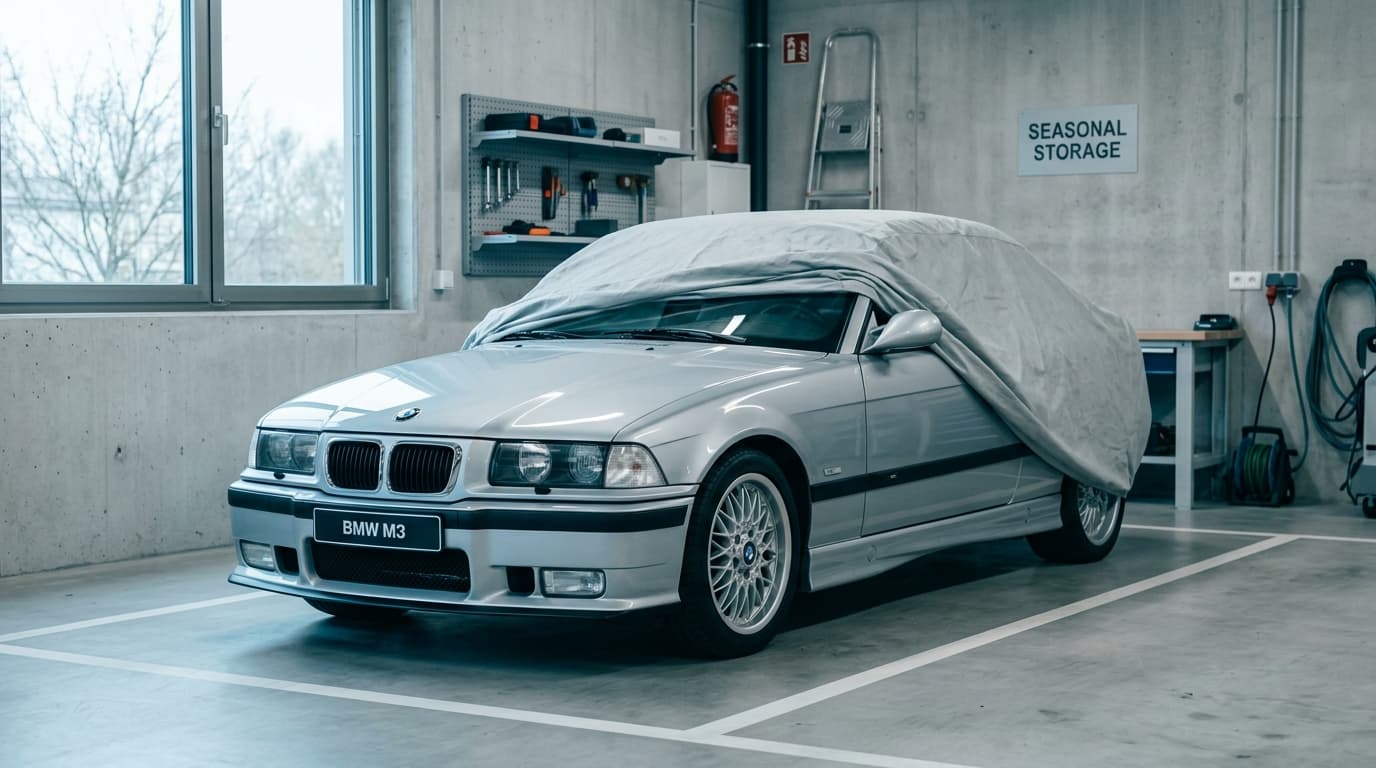
Many youngtimers take to the road mainly in the sunny spring and summer months. If your classic spends the frosty winter months well protected in the garage, a seasonal registration cuts the cost of keeping it dramatically. The operating period can be chosen flexibly, between two and eleven months a year. Within that period, both vehicle tax and the insurance premium are charged pro rata for the months the car is actually registered. That saves noticeably on fixed costs without your having to register and deregister the vehicle afresh every year.
Premium-free cover in the garage through dormant insurance
Deregistering your youngtimer for the winter break does not mean losing cover. The dormant insurance built into the policy applies automatically outside the operating period and continues to protect the resting vehicle at no extra premium. The condition for this is usually a permanent space in a locked garage or on enclosed private land.
- Pro-rata tax and premium: you pay vehicle tax and insurance precisely for the months of use you have chosen.
- Comprehensive dormant cover: where partial comprehensive cover is in place, protection against theft, fire, landslip or storm damage continues through the winter.
- Watch the no-claims discount: for the no-claims discount to rise for accident-free years, the vehicle usually has to be registered for at least six months of the year.
- No parking in public: outside the seasonal period, the youngtimer must not be left on public roads or car parks.
With the right combination of a seasonal registration and a tailored youngtimer policy, you enjoy complete freedom on the road in summer and cover your treasured car cost-effectively in winter.
The route to the best cover: a checklist for comparing the variants
Choosing between specialist youngtimer insurance, an ordinary motor policy and waiting for the "H" registration depends on specific criteria. If you own a well-kept enthusiast's car of 20 years or more, specialist policies often give you considerably better comprehensive terms than an ordinary standard policy.
Checklist: the right cover in 5 steps
- Check the conditions: specialist policies usually apply from a vehicle age of 20 years and often require an everyday car as well as a limited annual mileage, usually a maximum of 9,000 km.
- Establish the vehicle's value: a short valuation documents the current market value and gives the insurer a binding basis for classifying comprehensive cover.
- Compare the conditions of use: check whether an enclosed garage is required and which drivers are permitted.
- Choose comprehensive cover that allows for rising value: good policies include an escalation clause so that unforeseen increases in value remain automatically covered when you claim.
- Compare digitally and request your insurance confirmation: once you have chosen a policy, you receive your electronic insurance confirmation (eVB number) digitally straight away for the registration office.
This systematic approach makes sure your classic is neither under- nor over-insured. At nextsure you compare tailored specialist policies fully digitally and transparently, and get the eVB number you need in time for the start of the season.
Frequently asked questions
- From what age is a car called a youngtimer?
In Germany a vehicle generally counts as a youngtimer from the age of 20. From 30 years, a car attains official classic status and can be given an "H" registration. Around 18 per cent of all registered cars in Germany fall into the youngtimer category.
- Do youngtimers get an "H" registration or tax concessions?
No, the "H" registration with its flat-rate vehicle tax of 191.73 euros a year is reserved for classics aged 30 and over. Youngtimers are taxed by engine capacity and emissions class. A seasonal registration does, however, effectively reduce tax and insurance costs for the months you do not use the car.
- What distinguishes youngtimer insurance from ordinary motor insurance?
Ordinary policies only reimburse the often low current value on a total loss. A specialist policy is based on the documented market or replacement value. Specialist policies also often offer firmly agreed premiums with no loss of discount when you claim.
- What conditions do insurers require for a youngtimer policy?
Most providers require a minimum age for the drivers (often 23 and over), a second everyday vehicle and a garage space. Annual mileage is also capped, usually at up to 12,000 kilometres.
- Do you absolutely need a valuation for insurance?
For lower vehicle values, some insurers do without a paid valuation. A simplified digital self-assessment with photographs is often enough to set the sum insured up to a vehicle value of 100,000 euros.
- Is vandalism covered by youngtimer insurance?
Yes, high-quality specialist policies include wilful damage and vandalism in partial comprehensive cover already. Scratched paintwork or a broken-off wing mirror is therefore covered without paying for fully comprehensive cover.
Sources
Conclude directly online
Verified partner tariffs at no extra cost. The button takes you straight to the provider's calculator.
 OCC
OCC
Classic car insurance
Modular motor insurance for classic and collector vehicles: liability, partial and comprehensive cover, plus optional add-on modules.
- Coverage area:
- Europe and non-European EU territories
- Notice period:
- 1 month before the end of the insurance year
- Payment frequency:
- monthly to annual
- Motor liability for third-party damage caused by the insured vehicle
- Partial comprehensive: theft, hail, storm, glass breakage
- Comprehensive: additionally covers vandalism and accidents
- ComprehensivePlus (VollkaskoPlus): further damage while operating the vehicle
- Roadside assistance package, driver protection, and vehicle environmental-damage cover are optional
Key exclusions
- Damage caused intentionally
- Participation in motorsport events and races
- Damage to cargo
- Wear-and-tear damage (Comprehensive/ComprehensivePlus)
Sums insured and the deductible are set out in the individual application or policy document. Insurer: Provinzial Nord Brandkasse AG
Fact sheet: benefits, exclusions and waiting periods in detail
All details are taken from the provider's linked product page and the contract documents (IPID/policy conditions) published there; the insurer's documents prevail. Premiums, benefits and the insurance product itself may change – please verify the details directly with the partner before signing up; only the information provided there is binding.
Information last updated: July 2026 · Source: provider product information (IPID/policy conditions)