
Is Switching to Private Health Insurance Worth It? 2026
Is switching to private health insurance (PKV) worth it for high earners and the self-employed?
 Katrin StraubManaging DirectorInsurance expert with over 20 years of experience in the insurance industry.
Published on
Last updated on
12 min read
Table of Contents
Switching to private health insurance (private Krankenversicherung, PKV) is especially worth it for high earners, self-employed people, and civil servants who value excellent medical care. From an annual gross income of €77,400 in 2026, employees can switch systems. The decision requires long-term financial planning, since premiums are calculated based on age and chosen benefits. Individual advice helps with choosing the right tariff.
Income Thresholds and Legal Requirements
The Annual Income Threshold for Employees
Income thresholds largely determine who is allowed to switch systems. In 2026, employees must reach an annual gross income of at least €77,400, or €6,450 a month [3]. This threshold, known as the Jahresarbeitsentgeltgrenze (annual income threshold), is regularly adjusted by lawmakers. Only once a salary is expected to exceed this threshold in the following year too does mandatory coverage under the statutory health fund end. That opens up new options. Employees can then freely decide whether to remain a voluntary member of statutory health insurance (GKV) or switch to private health insurance. These income thresholds don't apply to self-employed people and freelancers. Regardless of their profit, they have immediate freedom of choice between the systems. Civil servants also benefit from the state subsidy (Beihilfe), which covers most of their healthcare costs [1].
Special Considerations for the Self-Employed and Freelancers
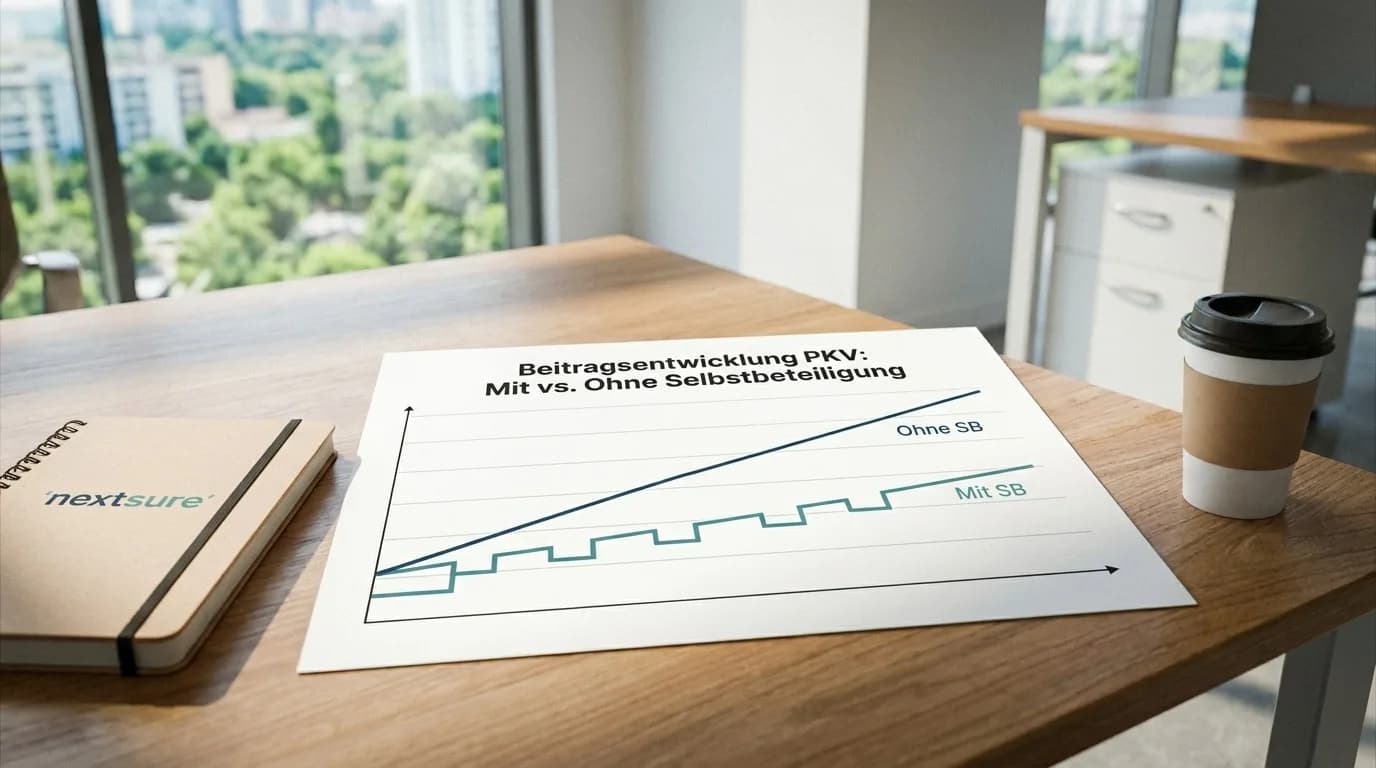
Self-employed people aren't subject to any mandatory-coverage income threshold and can take out private insurance at any time. However, this freedom also comes with a high degree of personal responsibility. Anyone who chooses PKV must bear the full premium themselves, since there's no employer contribution. The development of health insurance premiums should therefore be analyzed carefully. Especially during the startup phase, cheap entry-level tariffs are often tempting. Over the years, though, these can become significantly more expensive. A solid tariff with adequate age-related reserves is essential. nextsure recommends a detailed needs analysis here to avoid falling into a cost trap. Choosing the right tariff determines long-term financial stability.
Mandatory Long-Term Care Insurance
Anyone who switches to private health insurance must also take out mandatory private long-term care insurance (private Pflegepflichtversicherung) [5]. This component is legally required and covers the risk of needing long-term care. The benefits of mandatory private long-term care insurance exactly match those of statutory long-term care insurance. However, the premium is calculated differently. It's based on the age at entry and health status when the contract is signed. For married couples, there's no free family coverage here - each partner needs their own contract. That must be factored into budget planning. The notice period for canceling existing private health insurance is three months before the end of the calendar year [5].
Medical Benefits and Scope of Coverage
Free Choice of Doctor and Specialist Treatment
The scope of medical coverage under PKV often clearly exceeds the statutory level. Private patients benefit from free choice of doctor and can specifically seek out specialists or private clinics. Statutory health insurance operates under the principle of cost-effectiveness (Wirtschaftlichkeitsgebot): benefits must be sufficient, appropriate, and economical. PKV, on the other hand, reimburses state-of-the-art treatment methods and innovative medications not yet included in the GKV benefits catalog. A structural advantage. The value of a high-quality tariff shows especially in the case of serious illness. The insurer cannot unilaterally reduce contractually fixed benefits after the fact. This gives the policyholder lifelong planning certainty.
Dental Treatment and Vision Aids
Another focus area is dentures and vision aids. While statutorily insured patients bear high out-of-pocket costs for implants or inlays, good PKV tariffs cover up to 90 percent of the cost. Cost coverage for treatments like laser eye surgery is also included in many premium tariffs. GKV usually classifies such procedures as purely lifestyle treatments and refuses reimbursement. For glasses and contact lenses, PKV provides regular budgets. Anyone who places a lot of value on healthy teeth and optimal eyesight benefits enormously here. The exact reimbursement rates vary by chosen tariff and should be compared in detail before signing up.
Hospital Stays With Comfort
In the inpatient area, PKV offers clear comfort features. Being accommodated in a single or double room provides peace and privacy during recovery. Treatment by the chief physician or a recognized specialist is standard in most tariffs. Statutorily insured patients often lie in multi-bed rooms and are treated by the on-duty ward doctor. The difference in comfort is noticeable. In addition, private patients don't have to pay the statutory co-payment of €10 per day in hospital. Anyone who wants these benefits under GKV must take out a separate supplementary inpatient policy. PKV integrates these components directly into the main contract - contractually fixed.
Typical Additional Benefits of PKV
- Free choice of doctor and hospital worldwide
- Reimbursement of alternative-practitioner (Heilpraktiker) treatments
- High-quality dentures and implants
- Single room and treatment by the chief physician
- Cost coverage for modern vision aids
The exact benefits depend on the individually chosen tariff.
Cost Structure and Premium Calculation
Individual Risk Assessment
The cost structure under PKV is based on the individual equivalence principle. Unlike GKV, where the premium depends on a percentage of income, PKV calculates the premium based on age, health status, and scope of coverage. A healthy 30-year-old high earner often pays significantly less under PKV than the maximum GKV premium. That reduces the monthly cash-flow burden. Before signing up, however, there's a strict health assessment. Pre-existing conditions can lead to risk surcharges or benefit exclusions. Anyone already chronically ill often struggles to find an affordable tariff. That's why switching is especially worthwhile at a young age, while health is still in good shape.
Age-Related Reserves for the Future
Part of the monthly premium goes into what's known as age-related reserves (Altersrückstellungen). These reserves are meant to cushion age-related cost increases in the future. Since people statistically use medical services more often as they age, premiums would otherwise have to rise drastically. The reserves built up in younger years smooth out this increase. When switching PKV providers, these accumulated age-related reserves can, under certain conditions, be partially transferred [5]. Nevertheless, switching insurers later in life is often associated with financial disadvantages. Choosing a provider should therefore be a well-considered, long-term decision. nextsure helps with selecting financially strong companies.
Deductibles as a Control Lever
To lower the monthly premium, many policyholders agree to a deductible. That means a certain amount of annual healthcare costs is paid out of pocket. Only once bills exceed this amount does the insurance pay out. A deductible of €500 to €1,000 per year is common and noticeably reduces the premium. For employees, it's important to know that the employer doesn't contribute to the deductible - they only pay the subsidy toward the monthly premium. Anyone who rarely visits the doctor can save a lot of money through a clever combination of a deductible and a premium refund for claim-free years. That requires disciplined cash-flow management.
| Feature | Statutory Health Insurance | Private Health Insurance |
|---|---|---|
| Basis of calculation | Income-based (percentage) | Risk-based (age, health) |
| Maximum premium | Capped by the contribution assessment ceiling | Depends on chosen tariff |
| Family coverage | Free for children and spouses without income | Separate premium for each family member |
As of 2026. Individual variations are possible depending on the tariff.
Income Protection During Extended Illness
Daily Sickness Allowance for the Self-Employed
Income protection is a central component of private provisioning. While employees under GKV automatically receive statutory sick pay (Krankengeld) after six weeks of continued wage payment, privately insured people must explicitly arrange this protection. For freelancers in particular, being able to adjust daily sickness allowance for income protection is essential. The daily rate should cover ongoing fixed costs and living expenses. Self-employed people can choose flexibly when payments start, for example from the 15th or 22nd day of illness. An earlier start costs a higher premium. Daily sickness allowance is paid out tax-free and isn't subject to the progression clause (Progressionsvorbehalt). It thus provides a reliable financial base in times of crisis.
Protection for Employees
Employees under PKV also need daily sickness allowance. Otherwise, once the employer's six weeks of continued wage payment end, a massive income gap arises. The daily rate, together with the employer subsidy, must exactly match previous net income. A major advantage of PKV is that, unlike under GKV, the amount of daily sickness allowance isn't capped. High earners can insure their actual net income in full. Payouts are also made on Sundays and public holidays. It's advisable to regularly adjust the daily rate to salary increases. Many insurers offer a dynamic adjustment for this without a new health assessment.
Distinction From Occupational Disability
Daily sickness allowance only pays out for temporary inability to work. If the illness becomes a permanent condition, the insurer stops the payments. At that point, occupational disability insurance (Berufsunfähigkeitsversicherung, BU) applies. Protecting your earning capacity as a self-employed person and as an employee is therefore essential. Daily sickness allowance and BU pension must mesh seamlessly. Some insurers offer special transition clauses that avoid disputes over whether it's still a temporary inability to work or already an occupational disability. nextsure provides comprehensive advice on the optimal combination of these two essential types of coverage. Only this way is your standard of living permanently protected against serious health setbacks. An indispensable component.
Family Planning and Co-Insuring Children
No Free Family Coverage
Family planning under PKV requires precise financial calculation. Unlike the statutory fund, there's no free family coverage here. Every family member needs their own contract and pays their own premium. Premiums for children and teenagers are comparatively low, since no age-related reserves have been built up yet. Still, costs add up quickly with several children. If one spouse isn't employed, a full premium must be paid for them too. That ties up significant liquidity in the family budget. When planning a large family, the long-term costs of PKV require critical examination.
Assigning Children
How children are assigned depends on the parents' income. If both parents are privately insured, the children must also join PKV. If one parent is under GKV and the other under PKV, it gets more complicated. If the privately insured partner earns more and their income is above the annual income threshold, the right to free family coverage under GKV lapses. Parents must then either voluntarily insure the children under GKV for their own premium, or register them under PKV. This rule often leads to unexpected extra costs. Early advice from an expert is essential here.
Child Add-On Coverage Without a Health Assessment
A major advantage of PKV is what's known as child add-on coverage (Kindernachversicherung). Newborns can be registered under the insured parent's tariff without a health assessment and without waiting periods. Even if the child is born with a serious congenital illness or disability, the insurer must accept them under normal terms. The requirement is that the parent has already been insured under that tariff for at least three months and registration takes place within two months of the birth. Coverage then applies retroactively from the day of birth. That guarantees young families planning certainty during a sensitive phase.
Steps for Child Add-On Coverage
- Check the parent's prior insurance period (at least 3 months).
- Report the birth to the insurer within two months.
- Choose the appropriate tariff (must not be of higher value than the parent's own).
- Receive the policy without risk surcharges or a health assessment.
Deadlines must be strictly observed.
Premium Stability in Old Age and Returning to GKV
Premium Development in Retirement
Premium stability in old age is the biggest concern for many people interested in PKV. PKV premiums rise in old age independent of income, which can become a financial burden for retirees with declining income [4]. To counteract this, there's a statutory provisioning surcharge (Vorsorgezuschlag) of 10 percent, paid until age 60. In addition, the premium for daily sickness allowance no longer applies in retirement. Retirees also receive a subsidy from statutory pension insurance toward their PKV premiums. Nevertheless, premiums in old age often strain cash flow. Switching to the standard or basic tariff is then often the last resort for lowering premiums.
The Age-55 Threshold
Switching back to the statutory system is strictly regulated. Anyone older than 55 has almost no legal chance of switching from PKV back to GKV [2]. Lawmakers restrict the path back to prevent high earners from saving money in their younger years and then becoming a burden on the solidarity-based system in old age [4]. One of the few exceptions for people over 55 is family coverage through a statutorily insured spouse, provided their own income falls below €505 a month (as of 2024). However, this option is unrealistic for most high earners and former self-employed people.
Returning for Younger People
For policyholders under 55, a return is possible if mandatory coverage kicks back in. Self-employed people generally have to switch into an employment relationship subject to social security contributions in order to be readmitted to GKV [2]. Employees can return by lowering their gross salary below the annual income threshold, for example through part-time work [2]. Receiving unemployment benefit I (Arbeitslosengeld I) also triggers mandatory coverage. These steps require tough professional and financial sacrifices. The decision for private health insurance should therefore be viewed as a life decision. Lawmakers block constant switching back and forth between the systems.
Alternatives to Full Private Insurance
Supplementary Outpatient Insurance
Alternatives to full private insurance offer a compromise for the undecided. Anyone who doesn't meet the strict requirements, or is wary of the financial risk in old age, can stay under statutory health insurance and top up their coverage privately. Supplementary outpatient insurance as an alternative closes important gaps in GKV. It covers, for example, the cost of alternative-practitioner treatment, vision aids, or checkups that go beyond the statutory framework. This way, patients secure private-patient status with specialists without having to leave GKV entirely. A pragmatic middle step. Premiums for such supplementary insurance are moderate and easy to plan for.
Inpatient and Dental Add-Ons
Besides the outpatient area, supplementary inpatient insurance is in high demand. It guarantees accommodation in a single room and treatment by the chief physician during hospital stays. In dentistry, supplementary dental insurance protects against high co-payments for implants and high-quality dentures. By combining various supplementary components, the level of GKV coverage can be raised to nearly PKV level. The big advantage of this strategy is flexibility. Supplementary policies can be canceled during financial tight spots, while basic coverage under GKV remains in place. Free family coverage for children and spouses also remains untouched.
Cost Reimbursement Under GKV
Another option is the cost-reimbursement principle (Kostenerstattung) under GKV. Statutorily insured people can declare to their health fund that they choose cost reimbursement instead of the benefits-in-kind principle. They then present themselves to the doctor as a private patient, receive an invoice, and submit it to GKV. However, the fund only reimburses the amount the treatment would have cost as a statutory benefit. The patient must bear the difference to the private invoice themselves. Special residual-cost insurance exists for this. This model is administratively demanding but provides access to private doctors. It requires significant liquidity, since invoices often have to be paid upfront.
The Digital Switching Process With nextsure
Needs Analysis and Tariff Comparison
The digital switching process begins with a precise analysis of your individual life situation. As a digital insurance broker, nextsure offers a transparent comparison of hand-picked tariffs. Instead of a confusing grab-bag of options, the platform presents curated solutions tailored exactly to the needs of high earners and self-employed people. The algorithms take into account income, family planning, and health history. Within minutes, users receive a clear recommendation. That speeds up the process. Personal expert advice ensures that all questions about premium development and benefit exclusions are answered thoroughly. This hybrid approach combining technology and human expertise is at the core of the nextsure model.
Support Through the Health Assessment
The health assessment is often the biggest hurdle when switching. nextsure supports applicants in answering health questions correctly and completely. Errors or omissions can later lead to loss of coverage. The experts prepare the medical documents and, if needed, submit anonymous risk pre-inquiries to various companies. That prevents a negative entry in the central risk database (HIS). This professional process significantly increases the chances of being accepted under normal terms. The digital platform enables secure upload of medical reports and fast communication with insurers.
Long-Term Support and Contract Optimization
The service doesn't end once the policy is signed. nextsure supports its customers long-term and regularly checks whether the tariff still matches their current life situation. In the event of premium increases, the brokers analyze possible tariff switches within the same company under § 204 of the German Insurance Contract Act (VVG). In doing so, the valuable age-related reserves are fully preserved. The team is also available digitally and in person for submitting claims or adjusting daily sickness allowance. This holistic support approach guarantees that private health insurance remains reliable protection for decades. Data-driven optimization replaces hoping for the best here.
Frequently asked questions
- Who Does Switching to PKV Make Sense For?
Switching makes sense for healthy high earners, self-employed people, and civil servants who value high-quality medical care and can afford the premiums long-term, including in old age.
Sources
Free advice on this topic
Our experts advise you without obligation and find the right cover: online or by phone.
- Free & non-binding
- 100% digital