
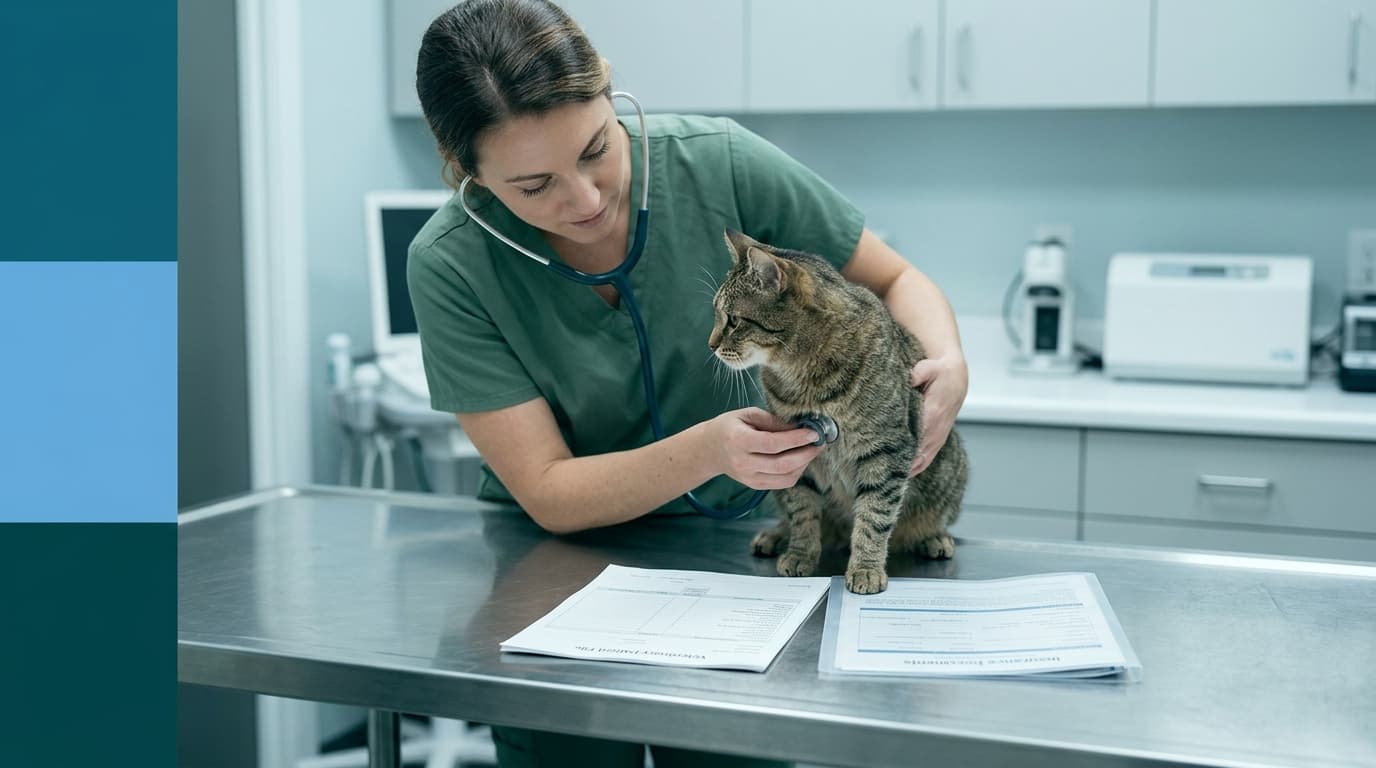
Cat Surgery Insurance Without a Health Check
Cat surgery insurance with no health check: how policies without health questions limit their risk, and why your pet's medical records decide the claim.
All details are taken from the provider's linked product page and the contract documents (IPID/policy conditions) published there; the insurer's documents prevail. Premiums, benefits and the insurance product itself may change – please verify the details directly with the partner before signing up; only the information provided there is binding.
 Katrin StraubManaging DirectorInsurance expert with over 20 years of experience in the insurance industry.
Published on
11 min read
Table of Contents
Yes, cat surgery insurance without health questions does exist. But waiving the check doesn't move the assessment away — it moves it back: in the event of a claim, your cat's patient records decide whether benefits are paid. We show which clauses carry this reservation and for whom the higher premium is worth it.
Cat health insurance
Comprehensive protection for your feline friend: The cat health insurance from nextsure covers vet costs and ensures financial security in case of illness or accident involving your cat.
Learn moreYes, but: Without health questions doesn't mean without assessment
Yes, cat surgery insurance without a health questionnaire does exist on the market. But they don't assess less — they assess later: instead of asking at application stage, they only ask when a claim is made, and there the veterinary patient records decide whether costs are reimbursed. Waiving the health check — that is, not asking about pre-existing conditions and previous treatments at application — is therefore not a free pass, but a shift of the risk assessment from the application stage to the claims phase.
Legally, this is governed by the pre-contractual duty of disclosure. This is the duty to disclose to the insurer all material risk circumstances known to you that it has asked about in text form. Under § 19 VVG, this duty only applies to circumstances the insurer has asked about in text form: no questions, no duty of disclosure.[1] So anyone who doesn't fill out a questionnaire also cannot face the insurer's rescission due to false statements in the application.
That is precisely why clauses that limit the same risk kick in elsewhere: waiting periods, tiered coverage and exclusions for pre-existing conditions. The assessment takes place at claims stage via the cat's patient records. The insurer reconstructs from the veterinary documentation what condition the animal was in at policy inception. So the decisive question is not: Were questions asked? But rather: What was already in the records at policy inception?
- With health questions: The assessment happens before the policy is taken out. Anyone who answers incorrectly or incompletely risks the insurer's rescission.
- Without health questions: The assessment happens after the claim, based on the veterinary documentation and the exclusion clauses in the insurance terms and conditions.
- In both cases the following applies: Insurance cover depends on the specific tariff, the documentation available, and the insurer's acceptance or benefits decision.
How tariffs without health questions limit their risk
An insurer that does not ask questions on the application has to compensate for the missing pre-screening in another way. The market standard in 2026 essentially provides three mechanisms for this. None of them is hidden: they are set out in the insurance terms and conditions and can be compared specifically before taking out a policy.
- Longer waiting periods: The waiting period is the period from the start of the contract during which no benefits yet become due. Around 30 days in general and 6 months for particular illnesses and operations are common; for individual diagnoses, some tariffs provide for up to 18 months. In the case of accidents, the waiting period is usually waived entirely.
- Graduated limits and reimbursement caps in the first contract years as well as annual maximum sums: they limit how much the insurer will reimburse at most per year and in the first contract years.
- General pre-existing condition exclusion: Illnesses, injuries and developmental abnormalities that the owner was aware of at the time of application remain permanently excluded, even without any questions being asked.
The consumer advice centre (Verbraucherzentrale) points out that pet health insurance policies carry many exclusions and that usually only healthy animals are insurable. Waiving health questions does not change this basic logic. It opens the door to taking out a policy, not the door to unconditional cover. So if you want to insure a cat with a known finding, you should compare not only the premium difference but above all the exclusion clauses.
The clauses that carry the reservation
The reservation is not in the advertising, but in the general insurance terms and conditions (AVB), the contractual document containing the binding benefit rules. Four types of clauses typically carry it. All of them can be read using the same question: what counted as known or documented at the start of the contract?
- Exclusion of known pre-existing conditions: There is no insurance cover for chronic illnesses or congenital, genetically caused or acquired developmental abnormalities that were known to the owner of the insured cat at the time of application.
- Six-month look-back period: Illnesses that were the reason for an operation within six months before the contract is concluded are excluded.
- Waiting-period diagnosis clause: If the date of diagnosis falls within the waiting period, the illness in question and its consequences are permanently not covered.
There is also the positive limit, and it makes the logic visible: with cleos, previous operations are insurable if they were at least 6 months ago, have fully healed and no follow-up complaints exist.[2] The insurer therefore waives the question and instead defines abstractly from which state a previous health event no longer matters. That is exactly the threshold you should look for in every tariff: it tells you where the line runs between insurable history and excluded reservation.
The patient record decides: condition at the start of the contract
How does the benefits assessment work in practice without a questionnaire? In the event of a claim, the insurer requests the veterinary documentation, i.e. findings, diagnoses and treatment histories from the practice or clinic. The cat's state of health at the start of the contract is decisive. If an illness was already documented or obvious at that point, the pre-existing condition exclusion applies, even without any questions having been asked about it.
Certain existing findings also lead to rejection or exclusion of benefits without any questions being asked. In the cleos small animal tariff, existing dental problems are an example of findings that prevent cover for the affected area.[2] Dental problems are also one of the most common reasons for operations in cats. So the patient record decides not only about edge cases, but about exactly the costs the policy is supposed to protect against.
A worked example shows what is at stake. The GOT, the fee schedule for veterinarians (Gebührenordnung für Tierärztinnen und Tierärzte), governs the billable rates nationwide. Under the GOT 2022, the castration of a tomcat including examination, injection and anaesthesia comes to around 88.88 euros net at the 1x rate, and correspondingly around 177.76 euros at the 2x rate.[3] A fall from a window with surgery, by contrast, can cost up to 3,000 euros.[2] The surgery insurance exists precisely for this difference: it steps in for high, unplanned procedures, not for routine treatment. Whether it pays out in an emergency depends on the state of the records at the start of the policy.
Who benefits from waiving health questions - and who doesn't
Whether waiving the health questions justifies the higher premium depends on three scenarios. Check which one applies to your cat before you compare policies.
- Young, healthy cat: Waiving brings little. Policies with health questions often offer more coverage per premium with a clean questionnaire, because the insurer can assess the risk precisely.
- Older cat without acute findings: Waiving opens the door to taking out a policy, but usually costs a higher premium and means accepting limits such as waiting periods and exclusions. The enrollment window on the market usually only extends to just under 10 years of age; after that, taking out a new policy becomes difficult or impossible.
- Cat with known findings: Here, waiving honestly changes nothing. The pre-existing condition exclusion applies regardless of whether questions were asked. The known finding stays excluded even in a policy without health screening.
If the second scenario applies to you — an older cat without acute findings — the next step is worthwhile: compare policies based on waiting periods, exclusion clauses, reimbursement rates and annual maximum sums, not just on the premium. A policy comparison shows you which provider accepts which medical history, and on what terms.
Outlook and next step: start your policy comparison
Policies, waiting periods and acceptance rules change constantly. What conditions will apply in the future, what age limits providers will set, and how the policy landscape will develop cannot be reliably predicted today. Always check the conditions in the current version of the respective provider's insurance terms and conditions.
- The general rule is: without health questions, the insurer shifts the assessment from the application stage to the claims stage.
- What tips the scales is your cat's condition at the start of the policy: the cleaner the findings in the patient record, the broader the actual coverage.
- A general article cannot settle your individual case, because that would require weighing your cat's specific medical history against the specific clauses of a policy.
- The next step is a policy comparison: it shows you concretely which providers work without health questions and what conditions they impose in return.
The policy comparison for cat surgery insurance from nextsure is exactly that next step: there you can see policy variants that cover medically necessary veterinary procedures including pre-surgical examination, aftercare and clinic stays, and you can put the terms side by side directly. nextsure compares, advises independently and brokers the contract; the respective risk carrier is the one that insures and pays out.
Frequently asked questions
- Is there a cat surgery insurance with no health check at all?
Yes. Some providers on the market do not include a health questionnaire in the application, but only a single health question or no questions at all. Example: Die Bayerische requires only one health question and confirmation of the acceptance requirements for its cat surgery insurance. However, the waiver does not mean that every cat is insured in any condition: the assessment takes place later via the veterinary patient records.
- Is my cat with pre-existing conditions insured if no health questions are asked?
Not automatically. Chronic illnesses or congenital malformations that were known to you at the time of application are excluded in such tariffs. Illnesses that were the reason for surgery within six months before the contract is concluded also remain excluded. If a diagnosis is made during the waiting period, that illness and its consequences are permanently not insured.
- How long are the waiting periods for tariffs without health questions?
A 30-day general waiting period and 6 months for particular illnesses and surgeries are common, as with cleos, for example. For individual diagnoses such as hip dysplasia or patellar luxation, special waiting periods of up to 18 months may apply. For accidents, the waiting period is usually waived entirely, and prior continuous insurance is often credited.
- What happens if a previous surgery of my cat is not asked about?
When no questions are asked, there is no pre-contractual duty of disclosure under § 19 VVG (German Insurance Contract Act) for circumstances not asked about. In the event of a claim, however, the insurer will request the veterinary documentation and assess the condition at the start of the contract. With cleos, previous surgeries are insurable if they were at least 6 months ago, have fully healed, and no residual complaints remain.
- From what age can I insure a cat without a health check?
The windows differ by provider. In the market example of Die Bayerische, the cat must be at least 8 weeks and under 10 years old at the time of conclusion; after that, a new enrollment is no longer possible, but existing contracts continue. For older cats without acute findings, a tariff without health questions can still be the only realistic option, albeit with a higher premium and limits.
- Is waiving health questions worth it for an older cat?
It depends. The Verbraucherzentrale Hamburg (Hamburg Consumer Advice Centre) points out that insurers usually only accept healthy animals and that policies carry many exclusions. For an older cat without known findings, the waiver can open the door. For a cat with documented findings, it changes nothing, because the pre-existing condition exclusion applies: in that case, you pay a higher premium for coverage that likely will not apply when it matters.
- What does a typical cat surgery cost?
According to the GOT (the German fee schedule for veterinarians), neutering a cat costs 89 euros at the 1x rate and 178 euros at the 2x rate, plus anesthesia, lab work, and materials. Larger procedures are considerably more expensive: as a cost example, cleos cites up to 3,000 euros for a fall from a window with surgery. It is precisely this range that is the reason the claims assessment via the patient records is so strict.
Sources
Conclude directly online
Verified partner tariffs at no extra cost. The button takes you straight to the provider's calculator.
 Hepster
Cat health insurance
Full health coverage for cats across four tariffs, from Basis to Superior0, with reimbursement of up to 100% and no annual limit.
- Reimbursement:
- 80-100% depending on the tariff
- Deductible (Selbstbeteiligung):
- 0-20% depending on the tariff
- Waiting period:
- 1 month
- GOT rate:
- up to 4x (from Premium)
- Treatment and surgery for illness and accidents, with reimbursement of up to 100% depending on the tariff
- Post-surgery physiotherapy: 3 sessions (Basis), 5 (Premium), 10 (Superior)
- Veterinary clinic stays: up to 10, 15, or 20 days depending on the tariff
- From Premium: dental treatment, neutering, homeopathy/acupuncture, and a wellness allowance of up to €150/year
- Vet fees covered up to 2x the standard veterinary fee schedule (GOT) rate on Basis, up to 4x from Premium
- Coverage abroad: 12 months in Europe; Superior extends worldwide for up to 12 months
Key exclusions
- Known chronic or congenital conditions
- Pregnancy, false pregnancy, and birth
- Illnesses treated in the 6 months before the policy started
- Diagnoses made during the waiting period (permanently excluded)
Trusted Shops: 4,5/5 „Sehr gut“ (2.600 Bewertungen)
hepster insgesamt (Anbieterbewertung, alle Versicherungen)
Monthly subscription: minimum term 12 months, notice period 3 business days before the end of the billing period; prosthetics/orthotics have a 12-month waiting period. Insurer: Towarzystwo Ubezpieczen Europa S.A.
Fact sheet: benefits, exclusions and waiting periods in detail
 Cleos Welt
Cat health insurance
Combined health and surgery cover for cats, reimbursing vet costs up to the agreed maximum veterinary fee schedule (GOT) rate.
- Reimbursement:
- up to the agreed maximum GOT rate
- Coverage abroad:
- 12 months
- Notice period:
- 14 days before the end of the month
- Treatment for illness and accidents
- Surgery, including pre-surgical diagnostic examinations
- Pre- and post-treatment following a covered surgery
- Lab work and imaging diagnostics, plus medically necessary medication
- Coverage abroad: 12 months
Key exclusions
- Treatments and surgeries already known or recommended before the policy started
- Illnesses occurring before the waiting period ends
- War, earthquakes, floods, epidemics, and pandemics
- Damage caused intentionally
CHECK24 Tarifnote 1,0 „exzellent“
Cleos Welt Katzenkrankenversicherung, Tarif Rundum Plus
CHECK24 Tarifnote 1,0 „exzellent“
Cleos Welt Katzen-OP-Schutz (Rundum Plus inkl. SOS-Schutz)
Google Rezensionen: 4,5/5 Sterne (210 Bewertungen)
Cleos Welt insgesamt (Anbieterbewertung, alle Versicherungen)
Contract term at least 1 year with automatic renewal; sum insured and deductible (Selbstbeteiligung) as stated in the policy. Insurer: Uelzener Allgemeine Versicherungs-Gesellschaft a.G.
Fact sheet: benefits, exclusions and waiting periods in detail
Hepster
Cat surgery insurance
Surgery-only cover for cats across four tariffs; the top tariff has no deductible and no annual limit on surgery costs.
- Reimbursement:
- 80-100% depending on the tariff
- Deductible (Selbstbeteiligung):
- 0-20% depending on the tariff
- Waiting period:
- 1 month
- Surgery under anesthesia or sedation for illness and accidents
- Post-treatment: up to day 14, 15, or 20 depending on the tariff
- Veterinary clinic stays: up to calendar day 10, 15, or 20 depending on the tariff
- From Premium: neutering, tooth extractions, post-surgery physiotherapy (up to 10 days)
- Prosthetics/orthotics: up to €400 (Basis), up to €500 (Premium/Superior)
- Emergency transport allowance of up to €50 per claim
Key exclusions
- Known chronic or congenital conditions
- Illnesses that required surgery in the 6 months before the policy started
- Surgery performed to meet breed-standard appearance
- Basis: dental treatment of any kind
Trusted Shops: 4,5/5 „Sehr gut“ (2.600 Bewertungen)
hepster insgesamt (Anbieterbewertung, alle Versicherungen)
Monthly subscription: minimum term 12 months, notice period 3 business days before the end of the billing period; prosthetics/orthotics have a 12-month waiting period. Insurer: Towarzystwo Ubezpieczen Europa S.A.
Fact sheet: benefits, exclusions and waiting periods in detail
Hepster Cat health insurance: Cat health insurance tariff overview
| Tariff | Reimbursement | Deductible | Annual maximum |
|---|---|---|---|
| Basis | up to 80% | 20%, min. €250 per claim | Year 1: €1,000, from year 2: €2,000 |
| Premium | up to 80% | 20% per claim | €10,000 |
| Superior10 | up to 90% | 10% per claim | none |
| Superior0 | up to 100% | none | none |
Hepster Cat surgery insurance: Cat surgery insurance tariff overview
| Tariff | Reimbursement | Deductible | Annual maximum |
|---|---|---|---|
| Basis | up to 80% | 20%, min. €250 per claim | €1,000 |
| Premium | up to 80% | 20% per claim | €10,000 |
| Superior10 | up to 90% | 10% per claim | none (surgery costs only) |
| Superior0 | up to 100% | none | none (surgery costs only) |
All details are taken from the provider's linked product page and the contract documents (IPID/policy conditions) published there; the insurer's documents prevail. Premiums, benefits and the insurance product itself may change – please verify the details directly with the partner before signing up; only the information provided there is binding.
Information last updated: July 2026 · Source: provider product information (IPID/policy conditions)